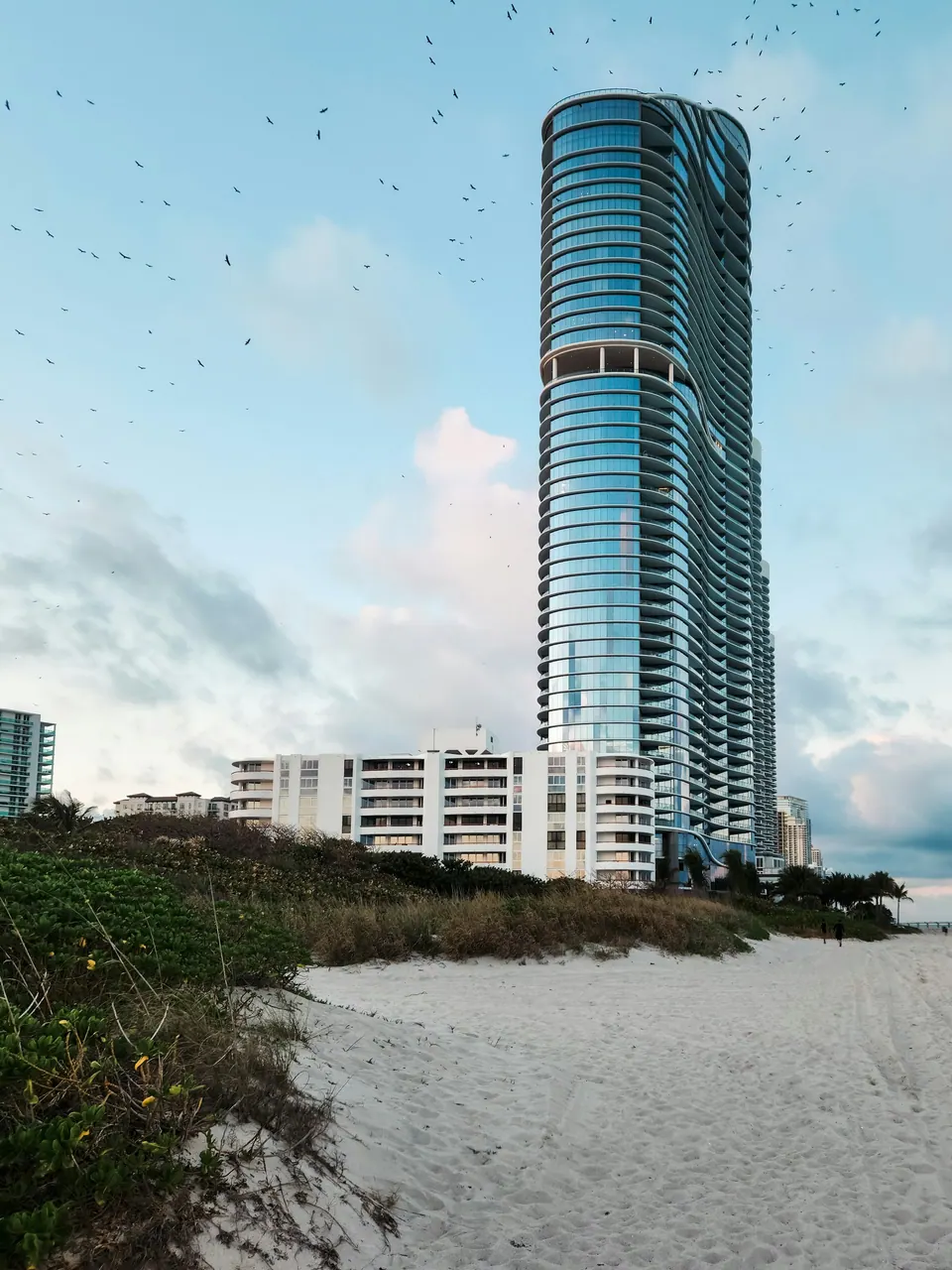
Miami has spent much of the past decade being described as an emerging prime market — a designation that has always slightly undersold what was actually happening. On the current reading from the Prime Index, it is the second-fastest-growing prime market in the Americas, with a 5.2% annual growth rate in prime residential values and a branded-residence premium of 32% over comparable conventional stock. It is not emerging. It is here.
The driver of Miami’s prime expansion is different in character from what is sustaining, say, Dubai’s. Dubai is capturing a global reallocation: buyers from multiple continents choosing a low-tax, high-service base as part of a considered restructuring of where they live and how. Miami is capturing something more regional in origin — a sustained movement of capital and, increasingly, people from across Latin America and the Caribbean, combined with domestic American wealth migration from higher-tax northeastern and west-coast markets.
The waterfront premium and what it means
Waterfront in Miami is not a uniform category. Biscayne Bay, the Miami River, Miami Beach’s Intracoastal, and the open Atlantic frontage of Surfside and Bal Harbour each carry different characteristics in terms of boat access, privacy, noise profile, and resilience planning. The buyers who are driving the upper end of the market are increasingly discriminating about these distinctions — they are not buying waterfront as a generic feature, they are buying a specific configuration of water, light, and address that corresponds to a clear preference.
The branded-residence product that has defined Dubai’s premium is now well-established in Miami, with a significant pipeline of operator-partnered projects along the waterfront. The 32% premium sits slightly below Dubai’s 35% but is consistent with a market that has a deeper pool of comparable non-branded prime stock against which the differential is measured. In a less liquid, less established prime market, the branded premium tends to look larger simply because the comparison stock is weaker.
Capital from the south
The cleaner observation about Miami’s current moment is about the composition of its buyer pool. Capital from Latin America — Brazil, Mexico, Colombia, Venezuela, Argentina — has been a feature of the Miami market for decades, but the profile of that capital has changed. What was historically often flight capital seeking safety is now more commonly the acquisition decisions of the first generation of established regional wealth that is globalising its portfolio. These buyers are not desperate; they are deliberate. They are buying Miami prime because it suits the structure of their lives and the logic of their allocation, not because it is the only available option.
That shift in buyer quality is consequential for market stability and for long-term value. The Miami hub sets out the current market in more detail, with neighbourhood analysis, transaction data, and the pipeline of new branded product expected to complete over the next thirty-six months. Miami’s moment is a function of geography, demographic momentum, and — not incidentally — an interesting built environment that continues to attract designers and developers who have something genuine to add.